SOCIO-CLIMP: Socio-Demographic Inequality in Climate Change Impacts
Climate change, along with the need for mitigation and societal adaptation to extreme weather events, ranks among the most urgent challenges facing contemporary societies. Projections indicate a rising frequency of climate-related extreme events across Europe in the near future, making it crucial to understand: a) socio-demographic disparities in exposure to climate events, b) differential vulnerabilities to extreme weather, and c) the effects of individual and contextual adaptation strategies. However, we lack comparative analyses at a granular spatial resolution that capture population heterogeneity - essential for addressing the distributional aspects of climate change.
The SOCIO-CLIMP project addresses these needs by investigating socio-demographic inequalities in climate change impacts across Europe, with three primary objectives:
SOCIO-CLIMP investigates the socio-demographic inequalities in exposure to extreme weather events (climate justice) and environmental hazards (environmental inequality) across 30 European countries,
SOCIO-CLIMP analyses disparities in vulnerability to extreme weather events - physical and mental health impacts of exposure - according to socio-demographic characteristics, and
SOCIO-CLIMP examines how variations in individual and residential contexts contribute to a) inequalities in exposure and b) disparities in physical and mental vulnerability.
Despite the availability of diverse climate indicators (e.g., heatwaves, floods, air pollution) and demographic data, comparative studies on environmental hazards and population heterogeneity remain scarce. Differences in data formats and spatial scales have hindered the cross-national comparison of environmental inequalities. This comparative perspective is essential for identifying contextual factors that may amplify or mitigate the extent of socio-demographic inequalities in exposure and vulnerability, thereby enabling more targeted interventions. SOCIO-CLIMP addresses these gaps by combining harmonized, granular demographic data with spatially precise climate and environmental data.
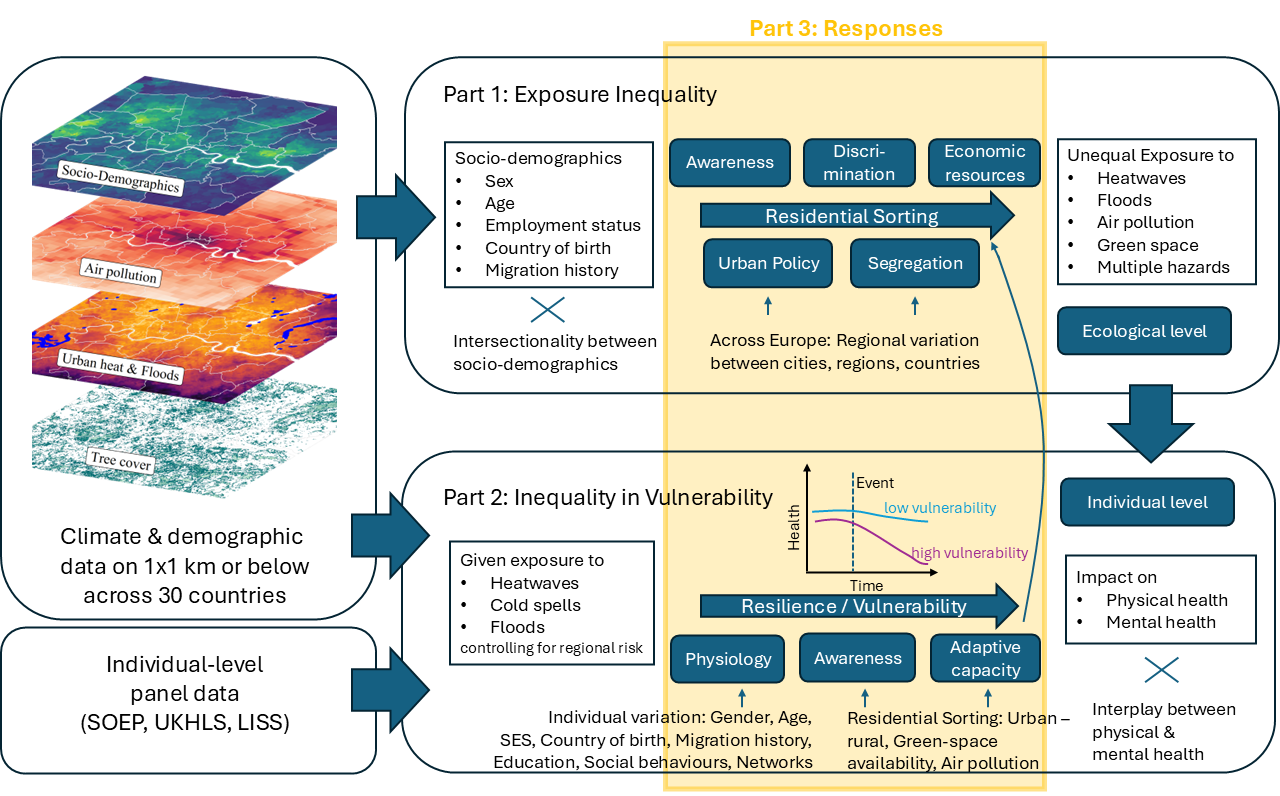
Figure 1 illustrates the theoretical structure of SOCIO-CLIMP. In the first part, SOCIO-CLIMP investigates exposure inequalities. Residential sorting and segregation processes lead certain socio-demographic groups to reside in areas with disproportionately high exposure to climate risks and environmental hazards. The extent of this unequal exposure likely varies across countries and cities and is shaped by contextual factors, such as segregation patterns and economic inequality. The second part of the project examines the unequal vulnerabilities associated with exposure to climate events. Some socio-demographic groups - due to lower adaptive capacities, limited awareness, and poorer physiological conditions - are more susceptible to adverse physical and mental health impacts. Here, individual and residential contexts (e.g., housing quality, access to green spaces) likely moderate the relationship between socio-demographic characteristics and vulnerability to extreme weather events. This vulnerability not only worsens existing inequalities in adaptive capacity but also reinforces residential sorting processes, perpetuating patterns of unequal exposure to climate risks.